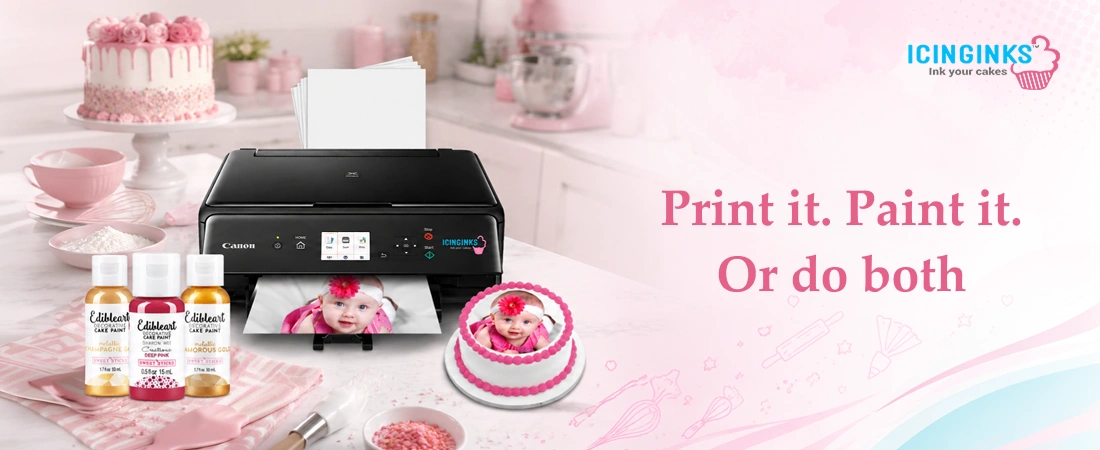
Not every cake design works with just one decorating method. Some creations need the crisp precision of edible printing, while others look best with the texture and artistry of hand-painted details. When it comes to edible ink vs. edible paint, the right choice depends on the finish, detail level, and creative effect you want to achieve. Many of today’s most eye-catching cakes combine both techniques to blend photo-quality precision with handcrafted character.
What is edible ink, and how does it work in an edible ink printer?
Edible ink is a food-safe ink used in edible ink printers to create sharp, high-resolution designs on frosting sheets and wafer paper. Using food-grade colorants instead of regular printer ink, it produces crisp, photo-quality images directly on edible surfaces.
One of the biggest differences in edible ink vs. edible paint is precision. From wedding portraits and corporate logos to full cake wraps and large-volume cookie orders, edible ink printing delivers clean, consistent results every time. Bakers rely on it for detailed graphics, text-heavy artwork, and professional-looking base layers ready for further decoration.
What is edible paint, and why do bakers love it?
Edible paint gives bakers the freedom to add hand-painted detail, texture, and personality that printed designs cannot replicate. Applied directly with a brush, it is perfect for metallic finishes, florals, lettering, gradients, and artistic accents that make cakes feel more custom and high-end.
There are different types of edible paints designed for different decorating techniques. Alcohol-based edible paints dry quickly, making them ideal for layering, fine detail work, and decorating surfaces like fondant, cookies, chocolate, royal icing, wafer paper, and modeling chocolate. Water-based edible paints, on the other hand, are better suited for softer watercolor effects, blended washes, and more fluid painting styles.
Edible ink vs. edible paint: understanding the core differences
Edible ink and edible paint may both decorate cakes, but they serve very different purposes. Edible ink delivers sharp, photo-quality prints on frosting sheets and wafer paper, making it ideal for portraits, logos, detailed graphics, and repeat orders that demand consistency.
Edible paint, meanwhile, is all about artistry. Applied by hand, it creates metallic finishes, brushstroke textures, florals, gradients, and custom details that give cakes a more handcrafted, dimensional look.
When to use edible ink and when to use edible paint
Use your edible ink printer when the design requires precision that a human hand cannot reliably produce. A client's face, a company logo, a detailed illustration, or any design that needs to look identical across multiple pieces; these are all printer jobs.
Use edible paint when the design needs to feel handmade, dimensional, or finished with a quality that printing cannot deliver. Metallic gold borders, painted florals, shimmer effects, and artistic brushwork all fall into this category. Paint is also the right choice when you are working directly on a surface that a printed sheet cannot adhere to cleanly.
The best part: using edible ink and edible paint together
Here is where things get genuinely exciting. Combining both techniques on a single cake produces results that neither tool can achieve alone. Printed precision meets handcrafted artistry, resulting in a level of detail and depth that makes cakes genuinely unforgettable.
How to combine edible ink printing and edible paint on one cake
Start by printing your design onto a frosting sheet, then apply it smoothly to the cake using piping gel. Once the sheet has fully adhered and dried, enhance the design with edible paint to add metallic highlights, outlines, brushstroke details, or hand-painted accents. Use thin layers and the right brush sizes to create a clean blend between printed precision and artistic detail.
Three combination techniques worth trying
Metallic accent on a printed design. Print your main image, apply it to the cake, then use Poppy Paints in gold or silver to outline borders, add shimmer to lettering, or highlight specific elements within the printed image. The contrast between the matte print and the metallic paint is striking.
Painted background with a printed focal point. Use diluted edible paint to create a soft watercolor-style wash across the cake surface, then apply a sharp printed image on top as the centerpiece. The hand-painted background gives the cake warmth and depth, while the print delivers precision.
Portrait enhancement. Print a photo-realistic portrait on a frosting sheet and apply it to the cake tier. Then use fine brushwork and edible paint to extend elements of the image beyond the sheet's edges, blending the print seamlessly into the painted surface for a fully immersive effect.
Why Icinginks is your complete edible decorating toolkit
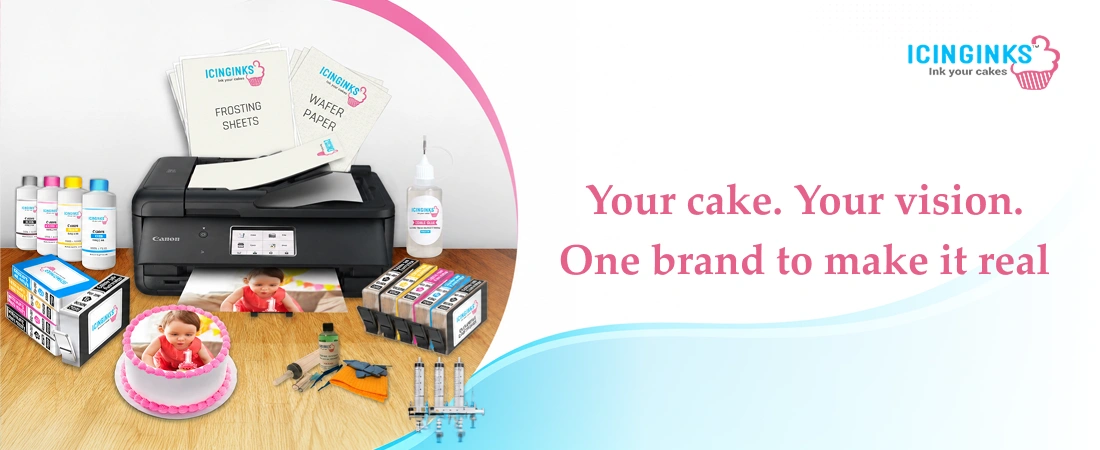
Whether you are printing, painting, or doing both at once, Icinginks has every product you need in one place. Here is what sets the brand apart for bakers who take their craft seriously:
- Edible ink printers and cartridges compatible with leading Canon and Epson models, built for vibrant, consistent, food-safe printing
-
Poppy Paints, fast-drying and alcohol-based, available in a wide range of colors, metallics, pearlescents, and shimmers
-
Sweet Sticks Edible Art Paints for water-based, softer painting techniques
-
Frosting sheets and wafer paper, FDA-approved, gluten-free, and allergen-free, are perfectly suited for edible ink printing and paint application
-
Food paint brushes to complement your painting setup
Two techniques, one trusted brand. Shop the complete edible decorating range on our website today. Call now for more information!
FAQs
1. Is edible ink the same as edible paint?
No. Edible ink is used exclusively in an edible ink printer to produce printed images on frosting sheets and wafer paper. Edible paint is applied by hand with a brush directly onto confectionery surfaces. They serve completely different purposes and produce very different results.
2. What surfaces can poppy paints be used on?
Poppy Paints work on any dry, solid confectionery surface, including fondant, gumpaste, cookies, macarons, royal icing, glaze icing, chocolate, isomalt, ganache, candy melts, wafer paper, and modeling chocolate. They should not be used on wet or porous surfaces such as buttercream, whipped cream, or gelatin.
3. Can you paint over a printed edible image?
Yes. Once a printed frosting sheet has been applied to the cake and allowed to dry and fully adhere, you can paint over it with Poppy Paints. Use a light hand, work in thin layers, and allow each layer to dry before adding the next. Avoid using water-based paints on printed sheets, as they risk smudging the design.
4. When should I use an edible ink printer instead of edible paint?
Use an edible ink printer when you need photo-realistic images, logos, or designs that need to be reproduced consistently across multiple pieces. If the design requires the kind of precision or detail that cannot be achieved by hand, printing is the right tool.
5. Does Icinginks sell both edible ink and edible paint products?
Yes. Icinginks offers a complete range of edible ink cartridges, edible ink printers, frosting sheets, wafer paper, Poppy Paints, Sweet Sticks Edible Art Paints, and food paint brushes, all available with free ground shipping across the USA on orders over $99.
Similar Post:
Zero-Waste Cake Decorating: How Edible Ink Technology Is Going Green
Mistakes to Avoid When Using Edible Cake Paint
How to Use Edible Paint to Decorate Cakes Like a Pro
How to decorate a cake with Edible Icing and Edible inks?